Introduction
Single-core droids will only be getting cheaper and there's plenty to choose from. But if you want to get the best out of a tight budget, making the right choice can prove to be a challenge. We're looking at two phones that launched at the same time and have very similar specs and price points. The Samsung Galaxy W and the Sony Ericsson Xperia Neo V are middle of the Android pack. There're many above them in the ranks but few are as easy to afford.
The Galaxy W currently costs slightly more, so we'll try and answer whether you get extra value or whether the Xperia Neo V is a real steal instead.

Before we put both phones through our battery of tests, we let them throw a few warm-up punches:
Samsung Galaxy W I8150 over Xperia Neo V
- Thinner (11.5mm vs. 13mm) and 11g lighter
- Faster processor: 1.4GHz over 1GHz
- DNSe sound enhancement technology
- Document editor over doc viewer
Sony Ericsson Xperia Neo V over Samsung Galaxy W
- Promised update to Android 4 Ice Cream Sandwich
- microHDMI port over no TV-Out
- Slightly higher-res screen: FWVGA (480x854) vs. WVGA (480x800)
- Scratch-resistant glass
- Currently cheaper
It seems the Xperia Neo V has a couple of advantages that catch the eye, the ICS update and HDMI port being most notable. That's a great start for the cheaper phone.
However, the Galaxy W hasn't given up trying to justify the extra cost. It's got a faster processor packed in a thinner body and dedicated sound-enhancing technology to boot.


Samsung Galaxy W I8150 • Sony Ericsson Xperia Neo V
It's hard to tell which way image quality and screen performance will swing. A few terse specs (WVGA, 720p) don't tell the whole story. So, without further ado, let's run the tests and see which phone comes out on top.
Galaxy W vs. Xperia Neo V: Vice Wersa
GSMArena team, 14 February 2012.
Software and hardware overview
The Samsung Galaxy W I8150 and the Sony Ericsson Xperia Neo V are almost the same size when viewed from the front - the Galaxy W measures 115.5 x 59.8 mm, while the Neo V is 116 x 57 mm.
Where they differ is thickness and weight. The Galaxy W is 10g lighter and is 1.5mm slimmer. With a profile of 13mm the Xperia Neo V borders on being the chubby kid in the gang. The extra 1.5mm really make a difference but the Neo V redeems itself with a digicam-inspired design and an actual shutter key.



Sony Ericsson Xperia Neo V
Let's have a look at the screens next. Both are 3.7" LCDs, but the Neo V has FWVGA (480x854px) resolution, while the Galaxy W offers WVGA (480x800px) resolution. That gives the Sony Ericsson a slightly higher pixel density - 265ppi - against the 252ppi of the Galaxy W and wee bit more vertical space for say, fitting a website in portrait.
We'll compare the screens in more detail in the next chapter.
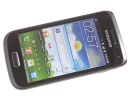

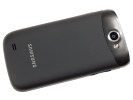
Samsung Galaxy W I8150
The chipsets inside both phones are from the Qualcomm 8255 Snapdragon line but the Samsung uses the T version - it's got a main processor running at 1.4GHz as opposed to the 1GHz of the Xperia Neo V.
Still, both have 512MB RAM and Adreno 205 GPUs, so the general performance should be pretty close and we expect a difference only in CPU intensive applications.
Moving down the spec sheet shows that both have the exact same imaging skills - on paper anyway. Each has a 5MP camera with LED flash, geotagging, face and smile detection and a secondary VGA camera. Both shoot 720p video.
Again, the cameras will be covered in more detail later.
Delving deeper into the specs reveals that both the Galaxy W and the Neo V have 5.76Mbps HSUPA, but the Galaxy has double the download rate - 14.4Mbps over 7.2Mbps HSDPA. This sort of difference will mater only if your carrier can offer this sorts of HSDPA speed in your region (which is not uncommon).
The Xperia Neo V comes bundled with a 2GB microSD card, while the Galaxy W has 1.7GB of user accessible built-in memory (and a microSD card slot too).
The Neo V has USB On-The-Go support, but its use is limited as you need Sony Ericsson's docking station to hook up a USB peripheral. There's been mixed user response as regards the range of supported devices too so we won't give it much point here.
As far as multimedia goes, the Galaxy W has DNSe technology which might give it the edge in audio reproduction, but the Neo V trumps it with a microHDMI port.

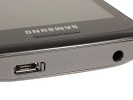
microHDMI and USB On-The-Go for the Neo V • DNSe sound enhancement for the Galaxy W
This means that if you're looking to hook up your phone to a TV to view photos and videos, the Neo V is the one to go for. But then, Sony Ericsson phones aren't known for their good video codec support, at least not out of the box.
The Sony Ericsson Xperia Neo V is limited to playing 720p MP4 videos, while the Samsung Galaxy W handled DivX and XviD videos in that resolution too. However you can always get a third-party player with better codec support for the Neo V but you can't do anything about the lack of a TV-Out option on the Galaxy W.
The Android OS itself is where we find the second big difference between these two phones. Both currently run Android 2.3 Gingerbread, but there's 4.0 Ice Cream Sandwich coming to the Xperia Neo V soon. The Galaxy W will never get ICS, at least not officially.
The Galaxy W does come with TouchWiz, which some might prefer over Sony Ericsson's customizations to the UI, and it has a document editor too (the Neo V only has a viewer).
We tested the loudspeaker performance of both phones and they both turned in Average results. You're unlikely to miss calls in most situations with both phones, but we've seen (or rather heard) much louder phones.
| Speakerphone test | Voice, dB | Ringing | Overal score | |
| HTC ChaCha | 63.3 | 61.2 | 72.7 | |
| 65.8 | 62.0 | 67.1 | ||
| Apple iPhone 4S | 65.8 | 64.5 | 74.6 | |
| Samsung Galaxy W I8150 | 69.6 | 66.6 | 67.0 | |
| Sony Ericsson Xperia Neo V | 68.0 | 65.8 | 71.7 | |
| Samsung Galaxy Ace S5830 | 71.0 | 66.7 | 67.8 | |
| HTC Explorer | 66.3 | 66.2 | 79.0 | |
| Sony Ericsson Live with Walkman | 75.6 | 66.2 | 78.1 | Very Good |
| 76.6 | 75.7 | 84.6 | Excellent |
So summing it all up, The Xperia Neo V and the Galaxy W are pretty close, but the Neo V wins in two major categories - the upcoming Android ICS update and the microHDMI port are strong arguments in its favor, even if it's got a slower processor and worse codec support out of the box.
Screen comparison
On paper, the difference between the Samsung Galaxy W screen and the Sony Ericsson Xperia Neo V screens boils down to an extra 54 pixels on the vertical in favor of the Neo V.
The 480x854px screen has standard aspect ratio of 16:9, ideal for watching videos. The Galaxy has 15:9 aspect ratio, which means there will be black bars around HD content. The different resolutions also mean different pixel densities as both screens have the same diagonal - 3.7". It's not something you'll notice though, even with the phones side by side. Theoretically, you should be able to fit more content on the Neo V screen when web browsing, for instance.
Screen comparison
The Xperia Neo V has scratch-resistant glass of unknown origin protecting its screen.
Both screens suffer some color and contrast loss when viewed at an angle but the Galaxy W holds up better overall.
The Xperia Neo V pulls ahead on brightness and contrast though. We couldn't get good measurements at 50% brightness (the phone just pushed the screen to 100% in the dark regardless of settings), but the results at 100% brightness are enough for a comparison.
The black levels of the Samsung Galaxy W are better than those of the Neo V. Typically, this is coupled with higher white levels, but that's not the case here, the Galaxy W screen is dimmer. The end result is 85% higher contrast in favor of the Sony Ericsson Xperia Neo V.
| Display test | 50% brightness | 100% brightness | ||||
| Black, cd/m2 | White, cd/m2 | Black, cd/m2 | White, cd/m2 | |||
| Samsung I9001 Galaxy S Plus | 0 | 251 | ∞ | 0 | 408 | ∞ |
| Samsung Galaxy Y S5630 | 0.4 | 247 | 624 | 0.75 | 471 | 625 |
| Samsung Galaxy Ace S5830 | 0.23 | 160 | 701 | 0.34 | 234 | 683 |
| Sony Ericsson Xperia mini pro | 0.57 | 346 | 609 | 0.9 | 641 | 714 |
| HTC Sensation | 0.21 | 173 | 809 | 0.61 | 438 | 720 |
| HTC Explorer | 0.26 | 201 | 768 | 0.47 | 358 | 755 |
| HTC Radar | 0.26 | 204 | 794 | 0.59 | 471 | 797 |
| Samsung Galaxy W I8150 | 0.29 | 243 | 853 | 0.50 | 423 | 853 |
| Samsung I9103 Galaxy R | 0.51 | 407 | 806 | 0.92 | 785 | 858 |
| LG Optimus 2X | 0.23 | 228 | 982 | 0.35 | 347 | 1001 |
| LG Optimus Black | 0.127 | 332 | 1228 | 0.65 | 749 | 1161 |
| Sony Ericsson Xperia Neo V | - | - | - | 0.35 | 548 | 1578 |
The Sony Ericsson Xperia Neo V features Sony's Mobile BRAVIA engine for improved image quality through software enhancements like contrast boost, sharpening and noise reduction. You can check outour review of the BRAVIA mobile engine for more details.
Both phones have their ups and downs in the display department. The screen on the Sony Ericsson Xperia Neo V is better, the poor viewing angels being the only major setback.
Still camera comparison
The cameras on both the Samsung Galaxy W and the Sony Ericsson Xperia Neo V have a raw resolution of 5MP and both do things like geotagging, touch focus and face and smile detection.
The Neo V does have 3D sweep panorama mode if that's important to you. There are third-party apps in the Android Market that can do a nice panorama too. Plus you need a 3D Sony TV set to appreciate the 3D in the Neo V's panoramas.
We have prepared crops that show the relevant parts of each chart we've shot, but you can view the full images in our Photo Compare Tool. We'll use the Samsung Galaxy Ace, which is slightly lower-end but priced the same as the Neo V.
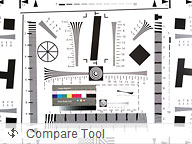
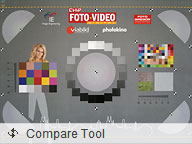

Samsung Galaxy W vs. Sony Ericsson Xperia Neo V vs. Samsung Galaxy Ace
The first chart is a best-case scenario - it gives each camera a chance to show off its capabilities with its simple black lines on white background.
We expected the playing field to be level, but the Samsung Galaxy W produced cleaner looking images. It has a notable advantage in both horizontal and vertical resolution. Photos from the Sony Ericsson Xperia Neo V look more processed.
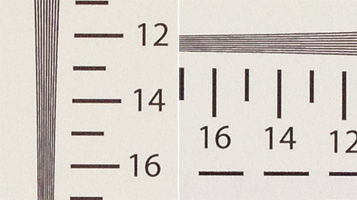
Crops from the Sony Ericsson Xperia Neo V, Samsung Galaxy Ace and Samsung Galaxy W
The Galaxy W solidifies its advantage in our second chart - noise reduction is slightly gentler to the white noise patch and the gravel and grass patches. The Neo V photos show some color noise and it's trying to artificially boost contrast, and it's overdoing it. Photos from the Galaxy W also show cleaner lines between the color squares, while in the Neo V's photos colors appear to bleed into each other.
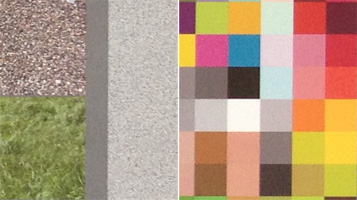
Crops from the Sony Ericsson Xperia Neo V, Samsung Galaxy Ace and Samsung Galaxy W
Finally, the third chart shows a more realistic scene. The Samsung Galaxy W shows good contrast, while the photo from the Sony Ericsson Xperia Neo V looks seriously washed out for reasons unknown. The Galaxy W oversaturates the colors, but the end result is more pleasing than the Neo V's photos, which had less detail too (take a look at the hair and the flower).

Crops from the Sony Ericsson Xperia Neo V, Samsung Galaxy Ace and Samsung Galaxy W
The Samsung Galaxy W has an advantage in all three camera tests and the Sony Ericsson Xperia Neo V left a lot to be desired. By the way, judging by these tests, we can almost safely assume the Galaxy Ace and the Galaxy W use the same camera module.
Video recording comparison
As we've seen several times already, there can be huge differences between 720p videos captured by different phones. So, while the Samsung Galaxy W and the Sony Ericsson Neo V both shoot 720p videos @ 30fps, we'll need to carefully examine samples from both.
We're throwing the Nokia Lumia 710 into the mix, which is currently priced the same as the Galaxy W and has proven to be a standard-setter at 720p video.
We've prepared crops that show the relevant parts of the image, but you can also view the full images here.



Samsung Galaxy W vs. Sony Ericsson Xperia Neo V vs. Nokia Lumia 710
Let's do the synthetic resolution chart first again. The difference in resolution isn't as clear as in the still camera, but it's still in favor of the Samsung Galaxy W. The black lines and numbers are crisper and there's a good deal of jaggies on diagonal lines. Still, both phones are far from what can be achieved with 720p resolution as the Lumia 710 shows.
The white background of the chart also reveals a pink spot.
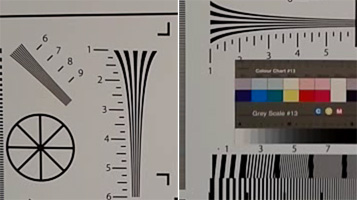
Samsung Galaxy W, Sony Ericsson Xperia Neo V and Nokia Lumia 710 crops from 720p videos
In the Ferris wheel setup, the Samsung Galaxy W resolves the grass a lot better. Colors are slightly off, but the image isn't as washed out as the Neo V's (same problem as in the still camera). The Xperia also shows more jaggies, we're not sure if it's worse downscaling (making a 720p image from the 5MP sensor), the lower bitrate or both.
With the Lumia 710, the grass looks great and you can even read the small banner ("bird's eye view"), which is completely illegible in videos from the other two phones.

Samsung Galaxy W, Sony Ericsson Xperia Neo V and Nokia Lumia 710 crops from 720p videos
Under low lighting, the comparison remains the same. The Sony Ericsson Xperia Neo V produces videos with rather low contrast, and the Nokia Lumia 710 videos are a bit too contrasty, it's still has the best video.
What matters however is that the Samsung Galaxy W retains its advantage over the Neo V.
Note that we didn't use the LED video light in this test, which is something that might help in low-light close-up shots.
Samsung Galaxy W, Sony Ericsson Xperia Neo V and Nokia Lumia 710 crops from 720p videos
Both the Samsung Galaxy W and the Sony Ericsson Xperia Neo V nail their target of 30fps framerate. The Neo V's records video with a bitrate of 6Mbps and stereo sound at 128Kbps. The Galaxy W doubles the video bitrate, but only does mono sound at 64Kbps.
You can put this down as another win for the Samsung Galaxy W - it shoots noticeably better videos. It's possible to get better 720p video at its price point, but a casual user should be quite happy with it.
Synthetic benchmarks
Looking at the raw clock speeds of the processors powering both phones, you'd think that the Samsung Galaxy W will have an advantage of around 40%. It's not all down to the CPU however, other hardware components and a finely tuned software can make a world of difference.
In CPU-intensive benchmarks like BenchmarkPi and Linpack, the advantage is actually around the 40% mark. The Galaxy W even approaches the performance of its dual-core sibling, the Galaxy R (which runs its two cores at a lower clock speed of 1GHz).
The Galaxy W is more expensive than the Xperia Neo V though. A Samsung Galaxy Ace that is currently priced the same as the Neo V fails pretty badly in these tests.


The Neo V has a slightly higher resolution (just under 7% more pixels), which puts it at a disadvantage in the 3D performance test. The difference in results, however, is much more dramatic - the Galaxy W tops 30fps, while the Neo V can't even hit 15fps. The Galaxy W shows practically the same result as the NVIDIA-powered Galaxy R.

Just for fun, let's throw some Windows Phone handsets into the mix for the web browser test - both use the exact same chipset as the Galaxy W. In this test, the Sony Ericsson Xperia Neo V recovers some lost ground and beats its opponent in both SunSpider and BrowserMark. The Windows Phones are far behind, barely managing to outpace the aging Samsung Galaxy Ace.
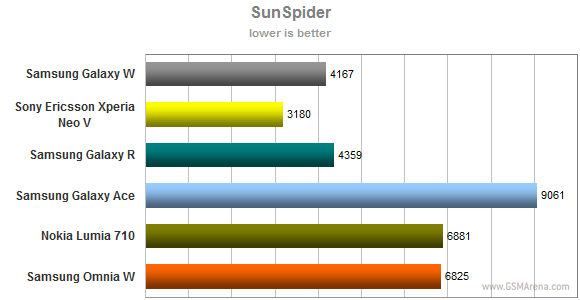

We expected the two phones to be practically tied in 3D gaming but results were strongly in favor of the Samsung Galaxy W, which clearly has the faster CPU too. Where it needs work is web browsing - here the Xperia Neo V beat it by a sizable margin, thanks to better software optimizations.
Audio quality
Both handsets did great in the first part of our audio quality test. The Sony Ericsson neo V is the winner here, due to its higher volume levels, slightly better frequency response (the Samsung Galaxy W has its extreme bass frequencies cut-off) and perfectly low intermodulation distortion.
Things are much closer with headphones plugged, the Galaxy W experiencing less degradation than its competitor. It wins by the slightest of margins in terms of stereo crosstalk and intermodulation distortions, while losing in the THD and frequency response readings by a comparable amount.
Overall the two smartphones are nearly identical in terms of audio output and users should be equally happy no matter which one they choose.
And here go the results so you can see for yourselves.
| Test | Frequency response | Noise level | Dynamic range | THD | IMD + Noise | Stereo crosstalk |
| +0.17, -1.32 | -87.8 | 87.4 | 0.011 | 0.122 | -87.3 | |
| +0.11, -0.10 | -89.6 | 89.2 | 0.014 | 0.037 | -80.9 | |
| +0.21, -0.97 | -85.2 | 85.2 | 0.013 | 0.211 | -54.7 | |
| +0.36, -0.11 | -89.3 | 89.0 | 0.100 | 0.291 | -49.7 |

Samsung Galaxy W I8150 frequency response

Sony Ericsson Xperia neo V frequency response
You can learn more about the whole testing process here.
Conclusion
We've had enough time to form impressions of these inexpensive smartphones. They're classic midrange packages with solid feature sets but the goal is clearly to stay within budget rather than impress anyone with specs.
For a few bills more, users are getting better performance (especially in games) and a better camera (both stills and video) out of the Samsung Galaxy W I8150. But they'll have to install a custom ROM if they want Android 4.0 Ice Cream Sandwich (Cyanogen Group is working on one).
Of course, the Samsung Galaxy W is not for geeks only, but they're usually the ones who care about benchmark scores and are keen on zooming into photos to look for artifacts.
Buying the Sony Ericsson Xperia Neo V will save you some cash and you'll be getting a hassle-free upgrade to Ice Cream Sandwich and a simple way to view photos and videos on an HDTV. It has the better screen and a faster web browser too.
The average user will be fine either way, knowing they got a good enough phone for a reasonable price. The Xperia Neo V is better than the Galaxy W on a couple of counts. It seems to be the one with more bang for your buck. Alternatively, the Samsung Galaxy W is the power player and also has the looks to go with it. We just don't think squeezing every drop of performance is make or break in this price range.

No comments:
Post a Comment